Wednesday, April 27, 2011

Missing the Rose Bowl in Rajasthan


            The only question on my father’s mind as he climbed up the cobbled steps to the 14th Century Hill Fort Keseroli in Alwar, Rajasthan was where could he watch -- or at least get the score of -- the Rose Bowl football game being played that day in the United States. Ever since his plane had touched down in New Delhi, he had been asking about the viability of watching his beloved University of Wisconsin Badgers on television or online. He asked flight attendants, sales clerks, my brother’s co-workers, boys in the street, and a blind fruit seller. Either they didn’t know the answer or they told him, as his children had repeatedly, that during the game he would be spending the night in a 14th Century fort and chances were very slim that there would be WiFi.  When my father doesn’t get the answer he wants he doesn’t sulk or curse before accepting the facts like most adults do, he simply looks blankly at the bearer of bad news, shrugs, turns to someone else, and asks them the very same question. He firmly believes that if he can find one person who has the right answer, the cosmos will reverse itself. 
            The Hill Fort was managed by a company called Neemrana, which has converted several Indian landmarks into hotels.  Each room was completely different, combining old world charm with modern touches.
            “Do you think that Du’s mind is going?” Erik whispered to me as we watched my father ask a bellhop where he could watch the game. It was clear that the bellhop didn’t understand English because his answer was to point to a space heater. 
            “No,” I whispered back, “he just hasn’t gotten the answer he wants yet.”
            “Are you sure he hasn’t forgotten that he asked forty people the same question yesterday?”
            “Totally sure.”
            My mother looked out of the window at the endless fields of mustard surrounding the fort, “Du, even if you could see the game, this is the last night of our road trip.  Don’t we want to spend it sitting around a fire with your children in a gorgeous old fort? There are some Rajasthani dancers performing at nine.”
            Du sat on the bed to take off his shoes, “Maybe one of the dancers will have a newspaper.”
            My brother and I backed out of the room and rejoined our own families. Murphy was thrilled with his bed that hung from the ceiling and wanted to sleep in it right away. But the fun of pretending to be knights in a castle with his brother proved too tempting and they both ran out of the room, down the steps, and into the courtyard where we could hear them prepare for battle. Pat and I retired to the private balcony to read and look out at the scenery.  Within moments, however, Keir appeared with news, “Hey guys.  I got online in the office and looked up the game.  It’s already over and the Badgers lost.  Should we tell Du?”
            Pat and I looked at each other then back at Keir.
            “Don’t tell him,” I said.
            “He’ll get depressed and go straight to bed,” said Pat.
            “Let’s tell him in the morning,” I said.
            “And admit that we withheld information from him?” Keir asked.
            “Absolutely not,” I said. “Admit nothing. Say that you just found out.  He’ll be too despondent to grill you about details.”
            Later, as the sun set and our families gathered to watch the dancing before dinner, Erik whispered to me, “Are we telling Du?”
            “Keir told you?” I whispered back through a tight smile. Du was sitting to our left, asking a waiter where he could get an English language newspaper. I heard the waiter answer, “New Delhi.”
            Erik leaned closer to me, “Yeah, Keir asked what we should do.  I was thinking that maybe we tell him right before he goes to bed tonight. That way, he’s going to sleep anyway.”
            “But then he’ll know that we were withholding the information during dinner.  Let’s do it in the morning.  We tell him we woke up and found the Internet.”
            “Found it?” Erik whispered.
            “Whatever.  We can hone the story later. But the timing of telling him in the morning is more plausible.  Then he can sleep off his depression in the car all the way back to Delhi.”
            Erik looked at the dancers setting up their instruments in the glow of the campfire and thought for a moment before turning back to me, “OK.  That sounds like a plan. I’ll tell Mom.” He stood up and I watched him walk over to my mother and whisper in her ear.  When he finished, Mom eyed me and gave a slight nod like a Mafioso authorizing a hit.
            The Rajasthani folk singing and dancing was so entertaining that my father seemed quite distracted from what had been his singular quest to find out the Rose Bowl score. And throughout dinner the adult kids kept up a flow of storytelling that swept Du along with it. When it came time for bed, we all retired feeling good about having withheld the bitter truth from our patriarch for our family’s last night together in India. 
The entrance

The courtyard

The private balcony

Paesels

Murphy and Zoe watch the musicians

Dinner

Bed


Wednesday, April 20, 2011

What I saw at the Keoladeo National Bird Park


          If Fhatapur Sikri made me feel like the mistress of a Mugul King, The Birder’s Inn (outside the Keoladeo National Bird Park in Bharatapur, Rajastan) made me feel like a pale-faced British widower from the turn of the last century who had been traveling for over a year throughout Asia in search of a rare warbler.  The flagstones in the lobby bespoke another era as did the gift shop full of drawings of birds stacked in piles, edges curling, dust thick, with no shopkeeper in sight.  After the usual hour-long check in for four families including passports and various papers being stamped and handed back to us, we were led to our rooms. During our trip, I often wanted to ask why such extensive documentation was required upon check in, but I was afraid the explanation would add an hour onto the process.
            Each family retired to their rooms chirping delight when their doors were opened, revealing charming, bird-themed rooms.  The boys immediately set up camp while Pat and I unpacked and quickly headed for the campfire in the courtyard with our bottle of red wine.  I come from a family of storytellers and gathering with my parents, brothers, in-laws, and children around a paraffin-fueled fire each night, was as much a highlight of the trip as India itself.
            The next morning we diligently woke early for our bird safari.  I managed to buy two bird books for the children from a waiter who seemed happy to take money intended for the gift shop. The boys flipped through the pages eagerly, folding down corners and circling birds they hoped to see.  We stepped outside the Inn, flagged down rickshaws, settled on a price, and took our chances on how knowledgeable our various drivers would be since they would also be our guides.
            Pat and I loaded the boys onto one rickshaw and grabbed our own to ride behind them. I snuggled up to Pat partly out of affection, but mostly for warmth, and watched our sons ahead of us, peering through their binoculars and flipping through their books.  I made no attempt to look for birds myself because I knew I wouldn’t see any. 
            I have unusually poor eyesight, so poor that I don’t have a driver’s license and even when wearing glasses over a pair of contacts, I have managed to mistake a burly construction worker for my eighty-year-old mother at twenty paces. My eyesight has been substantially impaired since birth, consigning me to life in a foggy otherworld, shadowy at the edges, peopled by dark shapes that can only be identified by their gait or voice.  And, although my family and friends have ample evidence that I can barely see (three car accidents with standing objects the only time I tried to learn to drive, my eyes being the subject of an article for a medical journal, and a lifetime of mistaking strangers for friends, friends for strangers, and sticking my hand out to introduce myself to mailboxes), they refuse to believe that I cannot see what they see. 
            At the bird park, our rickshaw driver and guide would pull up next to a group of other rickshaws that had stopped so their passengers could view a bird. Our guide would point toward a tree and say, “See? The Large Cormorant ?”  This one is male.”
            Pat would put his hands on the side of my head, as if to steer my gaze in the direction of the bird, “See, Brett, it’s right there.”
            I would strain to see it just to be agreeable and then give up, “No. No. I don’t see it. It’s OK.”
            “No, Brett.  It’s right there,” Pat would say insistently. He would stretch his arm out along the side of my head and point.  “Follow my arm.  Now see that lowest branch?”
            “No.”
            “It’s right there.  The bottom branch that looks like a V.”
            “Are you sure we’re looking at the same tree?”
“Of course. You’re just not trying hard enough,” Pat would exhale in frustration. “OK.  Try this.”  He would angle my head toward the ground, his palms flat against both sides of my head like blinkers on a horse. “Now slowly lift your head from here, straight up and stop at the base of the tree.” He would guide my head up slowly with his palms.
            I would peer into the distance, “Where’s the tree? Is that a man?”
            “No. It’s the tree. You’ve got it. Now don’t move yet.”  Pat would stretch his arm alongside my head again, “Now follow where I’m pointing.  There’s the V and if you follow the top of the V it points straight toward the Cormorant?  He’s right there, right there at the end of the top branch. You can’t miss him.”
            But of course I could, and always did, miss the Cormorant and the White-Breasted Kingfisher and the Collared Scops Owl with her adorable babies. And no amount of my protesting that I was having a marvelous time anyway, would dampen Pat’s and my family’s insistence that I simply try harder to see what they could see.  Even binoculars couldn’t help. I’d find myself zooming in on a stalk of grass only to lift them and see only white sky or the dark trunk of something. It was hopeless and I was absolutely fine with that.  But no one else was. It was as if my inability to see was really willful resistance. All my life I had been ruining everyone’s good time by stubbornly refusing to appreciate what was right in front of me for Christ sake. “All you have to do is see where that domelike knob is on the left side of the tree? OK, about halfway up from there switch to the other side of the tree and there’s an owl in the crook of that branch. No?  OK, how about this?  On the other side of the tree there’s a small bush. If you follow the line of the bush about half way up, then at a 90-degree angle there’s a vine hanging down. Follow the vine up and there’s a Finch right there. He’s right there, Brett.  See?  He moved his head. Oh look, he just hopped. He hopped! Why are you looking over there? Not there.  There. Right there.”
            After an hour of this, all of the rickshaws pulled up to a marsh. Adults and children stood along the path gazing out in awe. I dismounted, prepared for the usual drill.  This time, however, the view was so clear it was as if my nose was pressed up against the glass of a private universe. I could even see the birds because they were huge -- Painted Storks alight on the bare branches of a giant old tree.  I couldn’t imagine how these large, elegant birds could fly, let alone perch on such skeletal branches. The aerodynamic impossibility of the scene gave it a gothic beauty that slowed my breath. I stood there with the rest, for once seeing what they saw. And I was grateful.
           
Straining to see what the others see


The Marsh

Painted Storks

Closer. Picture:  Erik Paesel

Another great view
           

Wednesday, April 13, 2011

Akbar and Me at Fatehpur Sikri


             Walking around the abandoned city of Fatehpur Sikri made me feel like a girl. When I was younger, I lived in England and when my family visited castles I would lag behind my parents, daydreaming about being a princess who lived there.  The daydreams had an erotic tinge, though I wouldn’t have been able to identify that then.  Twelve and cursed with unusually thick glasses, I wasn’t creating a whole lot of heat in sixth grade. Correction:  No heat.  OK, I was creating negative heat. But when I walked around the ruins of castles, I could freely imagine being beautiful and desired rather than being voted “Mrs. Strange” by my classmates, a dubious distinction that I’ve never shaken amongst old friends.
            Fatehpur Sikri inspired in me many of the same romantic imaginings because it’s so intact. Built in the 1570s, it was occupied for only fifteen years by the court of Akbar the Great.  I could easily imagine myself in billowing mogul pants, breasts spilling out of my tight bustier, catching the eye of Akbar across the sun baked courtyard. 
            He would smile and incline his head toward one of the palaces available for a late afternoon tryst.  But I wouldn’t be that easy. I wasn’t like one of his mousey wives and concubines to be had for a mere trinket or a promise of social favors for my family. I was independent, an equal, and hotter than the sandstone walls of the Diwan-e-Khas. My name was Mona and I was a dancer. My signature move was a flawless backbend with one leg lifted, toe pointed to the heavens – leaving nothing to the imagination especially when I danced naked -- which I would only do if I liked you.
            “Mommy, Daddy says to tell you we’re all on that other side of the gate,” said a high voice, interrupting my thoughts. 
I looked down to see Murphy, “Huh?”
“We’re all on the other side of that gate. Daddy was worried about you.”
“Oh, honey. Tell him I’m fine.”
Murphy stood his ground, “Are you coming?”
“In a minute.”
“What are you doing?”
“Thinking honey. Just thinking. Run and tell Daddy I’ll be there in a minute.”
Murphy shrugged, “Uncle Keir says to hurry up.  He doesn’t want to drive in the dark.”
“All right. Give me a minute.”
Murphy scurried off.
OK. I’m not a dancer I’m a slave girl.  I’ve come to draw water from the well in the middle of the courtyard.  I lean over and feel a hand brush my ass through the thin silk of my pants. I’d know that hand anywhere. It’s the hand of Akbar the great.  I tremble as his hand lingers.  What if one of his wives sees us?  I might be forced to dance naked in front of the whole city. I stand, my water vessel sloshing water because I am still shaking. Akbar asks me who is my master, for he would like to buy me. I cannot look him in the eye. I look down and see that he is...
“MOMMY!!!” I turn around to see Spencer standing at the gate. “Are you coming?!”
“Yes. Yes. I’m coming.  I’ll be right there.”
Spencer disappeared beyond the gate. I started to walk toward it, slowly.
I’m not a slave girl. I’m the newest, youngest, and prettiest wife of Akbar, who has been summoned to meet him just beyond this gate. He frightens me with his gruff manor and large hands.  But I must obey the summons or he will force me to dance naked in front of the whole city. Once I step through this gate, I am completely his. Subject to his every whim -- powerless to resist his large hands and …
I walked through the gate and saw my family waiting for me in a clump.  Pat turned and walked toward me, “There you are. What were you doing?”
“Just imagining what it must have been like,” I said.
“I know,” he said, smiling.  “It must have been pretty wild.”
-- Oh my love.  You have no idea.
Fatehpur Sikri


Pat pointing something out to the boys


Spencer Leaping

Wednesday, April 6, 2011

The Taj Mahal


            I cannot remember the last time a destination exceeded my expectations as much as the Taj Mahal.  Hotel Sheela in Agra, on the other hand, squarely met them. Keir had told us that after several trips to Agra, he could discern no difference between a hundred dollar a night room and a fifteen dollar one.  Things got better only if we’d be willing to drop three hundred a night. The choice was clear:  Hotel Sheela. The establishment’s minor pest problem was offset by the availability of the hotel restaurant where my extended family could chat over meals being served one at a time, in no particular order, by a staff that seemed unprepared for our numbers.  I would have thought that this might charmingly be the actual case, were we not in Agra (home of one of the most visited tourist sites in the world) and had I not encountered this reaction from servers throughout our trip.  
            “Coffee?” a server would repeat my request, then turn his gaze into the distance as if trying to remember where he had heard that word before.
            “Yes. Do you have some?”
            “Yes, yes,” the server would reassure me, picking up my menu to scan it, perhaps for a clue. 
            “Any kind of coffee would be good.”
            “Yes,” the server would say, then call over another server to exchange a few words. When that server would disappear, our first guy would say, “He says. Yes.  Coffee, possible.”  Leaving me still unsure about whether a cup of Joe would actually materialize. No matter, this taught me a non-western brand of fatalistic patience and gave me some pure moments of surprised delight when sustenance arrived. 
There was some discussion over our unintentionally progressive meal that night, about waking up early to see the sun rise over the Taj Mahal.  The notion was abandoned in favor of sleep.  This turned out to be fortuitous, if only because the Taj Mahal was fogged in and at sunrise the view would have simply looked like an untouched canvas.
            As it was, at nine in the morning we could barely make out the Taj Mahal upon entering the gate.  I have been told that the sun glinting off of the white marble is truly magnificent.  I’m sure this is the case, but I quite liked to slow reveal of the mausoleum as fog burned off. Our guide came recommended to Keir and he was full of great anecdotes that impressed the children. He told us that the building took twenty-two years to construct and that many workers filed their fingers down to bloody nubs, inlaying jewels into the walls.  Once they had exhausted their usefulness, the story goes, Shah Jahan put them to death.  Guidebooks warn that there’s extensive mythology that has developed around the construction of the building in the mid-seventeenth century, so it’s hard to separate fact from fiction.  To my mind, there are two strains to both the mythology and the history.  One, the love story of a Shah that loved his third wife so much that when she expired after birthing thirteen of his children, he was driven to memorialize her by constructing the most beautiful resting place the world had ever seen. Two, the violent story of the shah’s son slaughtering all of his brothers and imprisoning his father so that the Shah could neither visit, nor look upon, his beloved wife’s tomb (except through a diamond reflecting the Taj Mahal that hung on a wall of his cell).
            The children were riveted. 
            And then there’s Shah Jahan’s OCD.  Everything about the Taj Mahal had to be symmetrical, from matching turrets and gates to the steeple atop the dome.  I’m a fan of asymmetry, myself, but the extent to which the Shah achieved his objective is staggering. Of course, if a designer stood to lose his life for pointing out that it might be a nice surprise to put one set of steps on an angle, chances are he’d stay mum and keep working like mad. I imagined Shah Jahan as a Mogul Howard Hughes with full blown dementia, “I said EXACTLY symmetrical damn it!  What part of ‘symmetrical’ do you not understand? The part that says 5 millimeters on the left means 5 millimeters on the right – not 6!  I KNOW it’s been 20 years and it’s going to be 20 more years until we get this RIGHT!  How many times to I need to say this? Keep the Taj symmetrical people, or I won’t wait until your fingers are bloody stubs.”
            The boys ran around the building, testing the symmetry by putting their eyes to grates and holding their arms out, delineating the middle, to see how everything matched up. We all watched the guide shine a flashlight through the jewels in the white marble to show how deep they had been inlaid. As I walked around the base of the mausoleum, I wondered why this building seemed more impressive, say, than the Giza pyramids or Notre Dame? The only answer that came to me was that the Taj Mahal is an incredible piece of architecture, precision, and artistry but it is also accessible.  I could touch the walls and walk on the marble floors in my stocking feet.  Even with thousands more tourists pouring through the gate, my connection to the building felt personal – intimate.
            It was hard to leave. As the family gathered at our exit and Keir paid the guide, I asked the boys if they had liked the Taj Mahal. They both declared enthusiastically that they had loved it and that it was a highlight of the trip so far. “Good,” I said, proud that I’d given my young sons a dose of culture that few American contemporaries get to experience.  “Keir says that on the way out of town, we’re hitting a Pizza Hut.”  They both jumped up and down excitedly, squealing their excitement and approval of the Pizza Hut choice.  They even made up a Pizza Hut dance as we waited for Erik and Shona to join us. 
            I didn’t ask if Pizza Hut had now surpassed the Taj Mahal as one of the highlights of the trip because part of the mythology of our family is that our passion for the arts and culture far outweighs our interest in common pastimes like chowing down on a slice.
            I’ll hang onto that for a little bit longer.

Checking out the carvings and the inlaid jewels

Symmetry through the grate, if you hold the camera right!

The boys testing out the symmetry from the middle line


The Pizza Hut dance (Zoe is celebrating behind them as well)

Wednesday, March 30, 2011

My Father at Hazrat Nizamuddin's Tomb


One would think that the biggest challenge of sightseeing with our four families would be keeping track of the four young children. That, however, proved less difficult than shepherding my eighty-year-old father. My father’s mind is as sharp as it ever was and he’s an adept traveler, but he never checks to see where everyone else is going and he has the attention span of an indulged king. He’s zealous about his own interests but is incapable of manufacturing even passing tolerance for things that don’t amuse him – or for events where wine and cheese aren’t served. As his daughter, I have experienced the upside of this trait. Making my father laugh is one of the greatest joys of my life because I know that there isn’t a chance in hell that he’s faking it. The downside is obvious. He wonders off, tunes out, and often stands up in the middle of a discourse, puts on his coat and heads out the door. If I’m a decent conversationalist it’s because I honed my skills by desperately searching for ways to sustain my father’s interest. When I was a child, we would accompany him to church to listen to the music.  But when the sermon started, my father would look down our pew and give “the nod”. At that point my family would rise en mass and follow him out the door.
            When Keir told us that the crowds teeming through the narrow streets leading to Hazrat Nizamuddin’s Tomb for gawwali (devotional sufi singing) were intense, I wondered if there was a way we could tether my father to my mother for the walk.  Sufism is a mystical sect of Islam and Hazrat Nizamuddin is one of its greatest saints, so devotees from all over India and other countries come to hear the singing at his tomb at sundown on Thursday nights.  It would be dark, chaotic, and there would be lots of shiny things hanging in small shops and stalls to attract my father’s attention. Chances of losing him were high.
            Pat stayed home since he’d been revisited by Delhi belly that afternoon. That meant a little more room in the van but fewer adults to manage children. We parked as close as we could, but like Varnasi, there was a point where the streets would be too narrow for the van (although not too narrow for hundreds of people, motorcycles, bicycles, and livestock). We organized on the curb.  Shona helped Erik strap their one-and-a-half-year-old son, Kiran, into a backpack contraption on Erik’s back. Keir hoisted Zoe on his shoulders.  I grabbed Murphy’s hand and asked my mother to grab Spencer’s. I’d learned from Varansi that it was easier to negotiate the crowds, one adult to one child.
            “But who has Du?” my mother asked, using my father’s nickname.
            “What do you mean, ‘Who has Du?’” I asked, gripping both of my sons’ hands tightly.
            “Brett,” my mother said, “If someone doesn’t watch him, he’ll wander off.”
            Already crowds were pouring into a cobbled street ahead of us. 
            “I’ll take Spencer,” Robyn offered.
            “OK,” I said.  “Mom’s got Du and everyone’s got a kid. We’re good.”
            Keir took the lead, racing off to the top of the narrow street, all of us jockeying for position behind him as he cut a swath.  My father started to walk in the direction of a stall of trinkets. “Du,” she said sharply and he fell back in line. 
            I overheard Erik and Shona debating the merits of negotiating the crowd with a toddler in tow.  However, as soon as Kiran was settled into his pack, he fell asleep – a toddler’s first line of defense.
            It seemed that everyone on the street was going to the same place and that I could simply let my legs go slack and be carried by the jostling wave of humans rolling toward the tomb.  By now, the boys were used to the routine and skipped easily over puddles and around dogs, respectfully saying “No thank you” to hawkers. There was an old world charm to winding streets.  The crowd bustled with courtesy and benign anticipation. I only saw a couple of western tourists.  I looked back to locate my father who did, indeed, look as if he was being carried forward by the crowd’s momentum as his head swiveled independently to check out the crowd and the shops. 
            As we turned a corner, we found Keir waiting with Zoe still aloft, “Guys, leave your shoes here.”  He indicated a pile of shoes off to the side. A man squatted near them arranging them with a stick as if he were stoking a fire.
            Keir paid the gentleman as we all kicked off our shoes.
            “How will we get them back?” Du asked.
            “Don’t worry about it,” Keir said, producing paper head coverings for the men and boys.  “And put these on.”  The boys giggled at each other’s hats as we women pulled scarves over our heads.  In stocking feet we continued to walk through more streets, passing more piles of shoes being poked with sticks by their keepers.
            “How will we find our pile of shoes?” I heard my father mutter to no one in particular. I didn’t know the answer. If the reclamation were up to me, we’d return to the van shoeless. But I had learned to trust Keir’s instincts and to adopt his attitude that if everything failed, there would still be a story in it. After a few more twists and turns, we found ourselves at the actual tomb -- women being directed into a partitioned area to the left, men being herded through an elaborate gate. 
            “Du,” my mother yelled as my father fell in line.  She was unable to finish the thought as we were corralled behind a grate.  It was dark in the corridor.  Some women sat in front at the grate, peering through tiny holes. My mother, Robyn, and I leaned over the women and peered too.  We could see the men, ours included, making slow progress around a tomb.
            “There he is,” my mother announced.  “I see Du. He’s there.”
            I looked at Spencer’s and Murphy’s solemn faces, freshly wondering at children’s ability to soak up a mood without fully understanding the situation.  Peering through the grate made me feel voyeuristic even though the men, presumably, knew that we were there. We were the unseen presence. Females.
            “There’s Du. He’s almost at the exit. I’ve got him,” My mother said, pulling away from the grate and continuing around so she could catch him when he emerged.  I could see Spencer and Murphy placing petals on the tomb. What were they making of all of this, I wondered?  I would ask, of course. But with children, the answer is often simply a shrug.  They were purely there. Looking.  Listening. Following.
            “There’s Spencer,” Zoe called out.
            “Yes,” said Robyn. “And Murphy.  And there’s Daddy.”
            We watched the men shuffle out and followed my mother out to intercept Du. A few more steps took us to a dimly lit courtyard that was surprisingly large after the tiny streets. We padded over to a step in our socks and sat down to wait.  I wouldn’t have guessed, but we had made it there ahead of most of the crowd. We watched as more and more people poured into the courtyard.  My father looked down our row and said, “I just don’t know how we’re going to find our shoes.”
            “We will, Du,” Robyn promised. 
            As the crowd swelled, men came out to move us around and to a couple of long bolts of cloth.  From our new vantage point, cross-legged in the courtyard, we watched men arrange themselves in two rows on the cloth.  Very shortly, we heard a call to prayer and the men kneeled in unison, bowing their heads to the ground (“Like ‘child’s pose’ in yoga,” Murphy later pointed out).  This was repeated a few more times before it stopped.  The men quickly dispersed and the bolts of fabric were rolled up. 
            By this time, I was sure that the courtyard must be filled to capacity. This did not stop men in white from pressing us all back to make room for musicians. My father stood at the back with Erik and Keir flanking him so he couldn’t wander, while the women sat on the stone floor with the children.
            “Look back there,” Robyn indicated with her head.  “The fingers through the grate.” I looked back to see fingers of women poking through the holes in a grate.  I had told the children earlier that women sometimes screamed during the singing to let out demons. That must have been a special zone specifically for screaming, since women were certainly allowed to sit in the courtyard.
            When the musicians were in place, the music started. I could see a keyboard that sounded something like a pipe organ and a horn or two. But the most identifying sound was that of drums, beating out a consistent rhythm that pulsed through the crowd. Being sensitive to noise, Spencer had to periodically put his hands over his ears.  Murphy rocked to the drumbeat and even sang along with some of the call and response.  The volume rarely dipped, but when it did, we could hear wailing and yelping coming from behind the grate. When Spencer first noticed it he glanced back, then burrowed closer into my side.  I put my arm around his shoulders and said into his ear, “Don’t worry. I’ve had days like that.”
            And I have.  Wouldn’t it be great, I thought, to be able to go somewhere safe on a weekly basis and scream out my demons?
            After a few minutes, Spencer relaxed and my ass started smarting from the stone floor.  I left the kids with my mother and snaked my way through the crowd to stand with my father and brothers. As a song ended and another started, my father scanned the exits and said to Keir, “I’m done. Can we go?”
            Erik put his arm around my father and said, “Haven’t you heard?  They serve wine and cheese afterwards.”
My father taking in the scene as Keir leads

Du with Spencer, Erik, and Kiran, donning hats and leaving shoes

The boys waiting with Robyn

Me waiting for the singing with my parents (photo: Erik Paesel)

Kiran looking back from the crowd as the men clear a space for the musicians (photo: Erik Paesel)


Wednesday, March 23, 2011

On Death and Stogies at Humayun's Tomb


            Humayun’s tomb in New Delhi was built for him after his death by his widow.  Apparently, Humayun keeled over unexpectedly in his library, leaving all of his funeral arrangements to the wife. She must have thought a lot of him or wanted the world to think a lot of him, because it’s an impressive tomb by anyone’s standards--except perhaps Shah Jahan’s, who built the Taj Mahal. Upon entering the gate and gazing at Humayun’s domed tomb, I imagined Shah Jahan standing in the same spot saying, “It’s nice and all, but…how do I put this?  It needs a little something…” 
            The boys had the proper amount of irreverence for the long dead and, along with Zoe, ran across the grounds and up and down steps as if the entire building were a play structure.  Come to think of it, if I were inclined to build a massive monument to house Pat’s or my corpse, this would be the image that might make it worth it.
            As the children charged ahead of us, I wondered about the stories we make up about our loved ones after they’ve passed.  What memories do we hang onto and which ones fade? How does the deceased person’s story mutate? According to my dad, his mother reviled his father in life. Yet, after his father died, his mother kept his last charred cigar stogie propped in an ashtray like a shrine.  In death, his father became her beloved.  In life, he had been her alcoholic, abusive, son-of-a-bitch. For all we know, this is what happened to Humayun’s widow. Now that the guy was sitting up there in probably the best level of paradise money could buy, he didn’t look half bad.
            I have the usual fears about dying, including the ridiculous one that I’ll simply look bad doing it. This is not quite as frivolous as it sounds. I’m afraid of scaring the children. But all of my fears tend to swirl around the actual process of dying. I’m not remotely worried about being dead or being forgotten. Because by then I will be dead and I hope not to care about such piffling things. I mean, if death isn’t transformative, what is?
            Like all mothers, I worry about leaving my children alone too soon. I harbor the illusion that I am currently indispensible. But when they are older, I believe that I will have been successful as a parent if I am not at the center of their lives.  So a tomb would be the last thing I would want. 
Some people do want tombs and some people build them. Some preserve stogies and rewrite history.  As I watched the children charge around this ancient monument, I wished only that my children would always be able to feel like this.  Limitless and not looking back to see where I am.


Waiting for me with my parents


Tuesday, March 15, 2011

Passing Through -- A Day in Delhi


            After Christmas my parents and my other brother Erik and his family arrived in New Delhi. This required a bigger van and our visit definitely bumped up a notch in style. My parents are troupers, but need their naps and a few comforts like some heat and a bathroom where they have somewhere to sit so they won’t topple over. Erik and his wife, Shona, were carrying around their year-and-a-half old son who also needed naps and places where he could topple over. 
            Thus began the portion of the trip that was characterized by loading eight adults and four kids into a van that Keir valiantly drove through traffic that made Hollywood freeways look like child’s play. The chances of our being sideswiped by an indifferent driver or of us completely rubbing out a family of four on a motorcycle seemed incredibly high.
            Our first day out, we started with breakfast at the Imperial Hotel in New Delhi. If you want to impress the folks, the Imperial Hotel will definitely do it.  It’s a gleaming example of Raj imperialism, replete with framed prints of colonial rule lining the vast, long hallways.  Restaurant 1911 is one of several in the hotel. 1911 is the year that George V and Queen Mary were crowned Emperor and Empress of India. It was also the year that New Delhi was designated India’s new capitol city. If you’re somewhat dubious about why this period of history is being celebrated in a hotel built during India’s occupation by her occupiers, you’re not alone. It felt something like eating breakfast at a beautifully restored slave plantation in the south. That said, the scones and to-die-for Indian fare are not to be missed. And I could hold a business meeting in the bathrooms. Members of my family kept popping up and down to visit the imperial loo whether the need was pressing or not.
            After lingering in the halls for a bit, we jammed into the van and headed to a stepwell (this one called, Agrasen ki Baoli).  As it’s name implies, a stepwell is a very large well with steps leading down into the water.  Agrasen ki Baoli was built in the tenth century and people have been bathing in it for centuries. Only when we visited it, it was dry. As our four families climbed around on the steps, I looked down to the bottom of the empty well.  What must it have been like, say, five hundred years ago when families gathered on the steps to pull water, while the young ones splashed each other? A simple thought occurs to me in historic spots like this – we human beings have always needed the same things and have sought to fulfill those needs in similar ways throughout our short time here on the planet. In this case, we’ve needed to cool off, come together, and relax. These days my family does the very same thing in the two saltwater infinity pools on our housing complex in Los Angeles. Those Indian folk, five hundred years ago, could not envision the palm trees and automobiles whizzing past outside walls of our private pools. But the desires that drew us to water are the same.
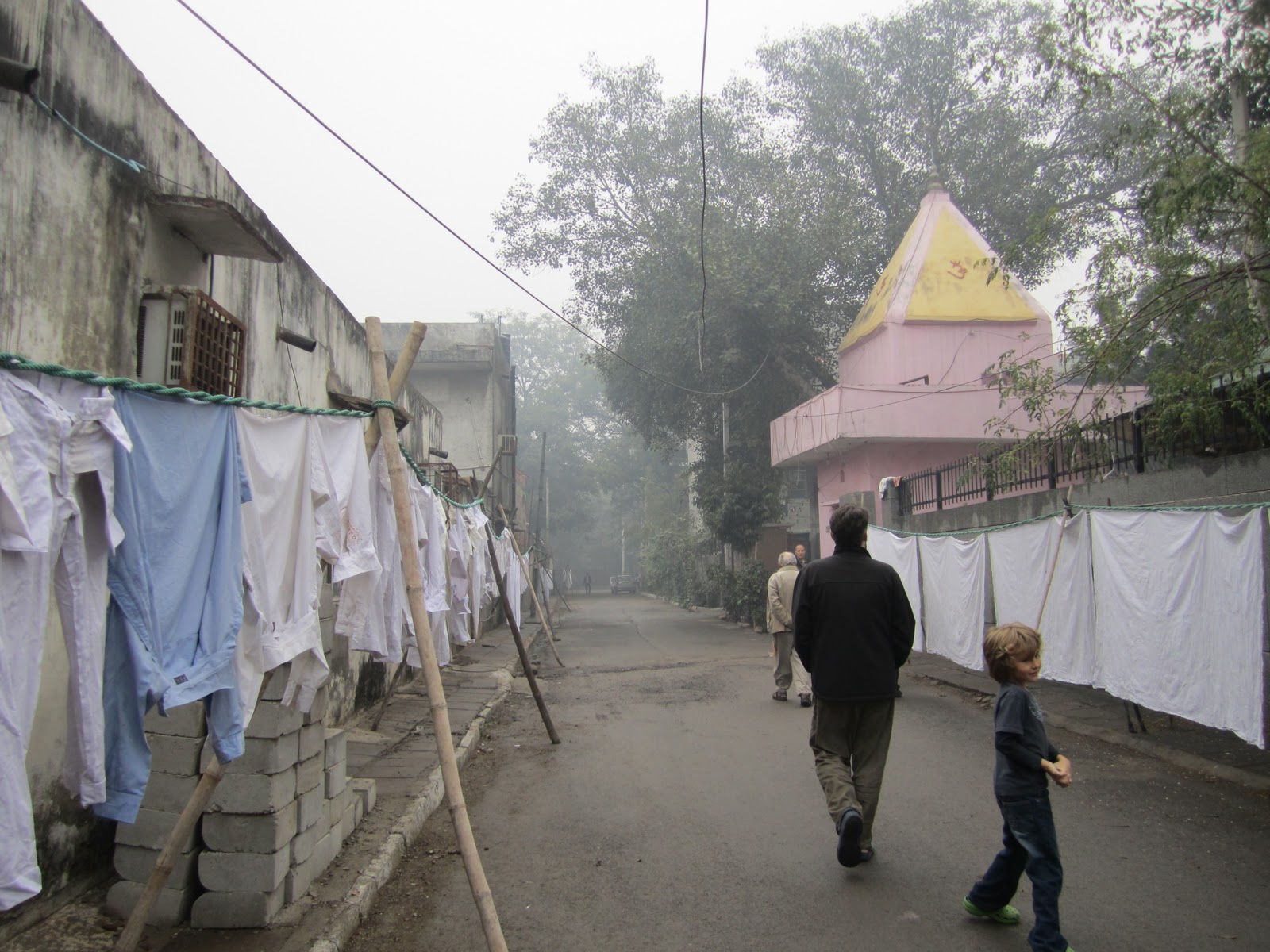
            With our Imperial breakfasts still heavy in our stomachs, Keir walked us down an alley from the stepwell to a hand laundry. Drying sheets anchored to wires flapped in the drizzling rain as we approached. The laundry was open air, which was probably practical when it was hot. But today was cold and watching the men scrub clothes and sheets in tubs made my hands sting. We walked up and down a bit, smiling to the workers. The work looked hard and boring. Thinking of myself doing the same work made my stomach sour. The collective mood in the place, however, seemed more practical than joyless.  Keir stopped to ask a few questions.  Spencer and Murphy somberly took in the scene. Pat stopped to talk to a gentleman who spoke a little English.  The boys and I stopped to listen. The man said that he worked from 5am to 10pm. Answering Pat, he said that they took breaks and that they sometimes sang as they worked. His father had been a washer, and so had his father, and his father, “Five generations, we wash."
            “You have a son?” Asked Pat, indicating both our boys.
            “Oh yes,” the man smiled, acknowledging Spencer and Murphy.
            “Is your son here?” Pat asked.
            “Oh no.”
            “Did he wash when he was a boy?”
            “Oh no.  My son…school.  My son, very…” he tapped the side of his forehead indicating ‘smart’, “My son work job.  Never wash.”
He reached into his pocket and pulled out a worn business card and handed it to Pat.  “My son in tech.  He will have better life.”
            Pat looked at the card and started to hand it back to the man who shook his head, smiling again, “You keep.”
Pat smiled politely and put the card in the pocket of his jeans.  He stuck his hand out to shake and said, “So nice to meet you.”
The gentleman took Pat’s hand in both of his and said, “So nice to meet you. Yes.”
            Later, as we walked down the alley outside the laundry, Spencer started to cry. The others were walking ahead of us. I stopped and put my hand on his head, “What’s the matter, my love?” Spencer shook his head.  “You don’t want to talk?”
            “No.”
            “That’s OK,” I said.  “It’s OK not to talk. But remember that sometimes talking makes you feel better and I might be able to help you work things out.”
            He paused for a minute to consider this or perhaps, simply, to find words. I stayed still, looking down at him. I slid my hand from the top of his head to his cheek and held it there. Most of the others were still walking.  Pat had turned and was watching us, Murphy hanging onto his hand. Tears trickled down Spencer’s cheeks into my palm.  Slowly, deliberately, he said, “I can’t believe that people live like this.”
            “I know,” I said, mentally searching for something to say that would be comforting. But all I could come up with was something that was true, “But some people do live like this, honey.”
            “It’s so sad,” he said, scrunching his eyes.
            “Yes,” I said. I threw Pat a look of appeal and he quickly walked back toward us, Murphy trailing.
            I said to Pat, “Spencer is sad because people live like this.”
            Murphy hung behind Pat, looking at Spencer with concern. Pat inhaled, took a moment and then said, “I know it’s sad, Buddy.  And I’m sure that those men would like to have easier jobs or better conditions.  But we shouldn’t assume that they are unhappy.  They have families and whole lives.  Remember that man I was talking to?  He was really proud of his son.  And when he was talking about his son, he sounded happy. Just like I sound when I talk about you.  We shouldn’t assume that people who have a lot less than us are miserable.”
            I wanted to tell Spencer that just because human beings are resilient doesn’t mean that we shouldn’t sympathize with those who have less or work to make the world better for everyone.  But I could tell that he had a lot tumbling around in his head. I’ve learned to trust the workings of his mind and heart. He had what he needed. He would find his own answers, not mine. I also knew that the answers would change over time. My ten-year-old answers are not my fifty-year-old answers. That too, however, was his to discover.
            So I said nothing more, but slipped my hand into his and we started to walk away from the laundry, back in the direction of the stepwell and the van.  In one day, I thought, we had walked through the distant past, the recent past, today, and tomorrow. “My son in tech.”  I had a powerful sense of passing through time. I squeezed my son’s hand, hearing the words of Carl Sagan in my head, “We have traveled this way before, and there is much to be learned.”

Spencer reading at breakfast at the Imperial Hotel
The Imperial Hotel


Spencer at the stepwell

An image of the stepwell a couple of years ago
Pat and Murphy outside the Hand Laundry
The Laundry